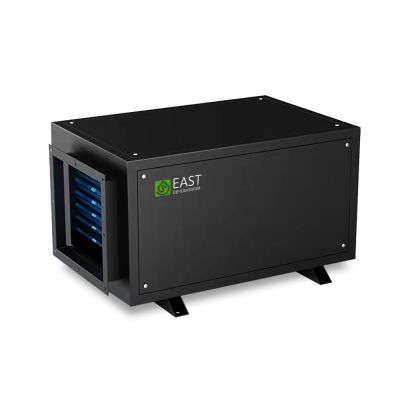
Custom Industrial Dehumidifiers Manufacturer - Delivered in 15 days.

What is the noise level of a ceiling mounted industrial dehumidifier?
Small ceiling units of 20 to 130 litres per day typically measure 45 to 55 dB(A) at 1 m; three-phase machines from 168 litres per day upward run 68 to 75 dB(A), and the largest 720 litre frames sit at 75 dB(A). Mid-size ducted models are published at 49 to 50 dB(A) measured at 3 m. Resilient hangers and flexible duct connections take the structure-borne part out.
Where the sound actually comes from
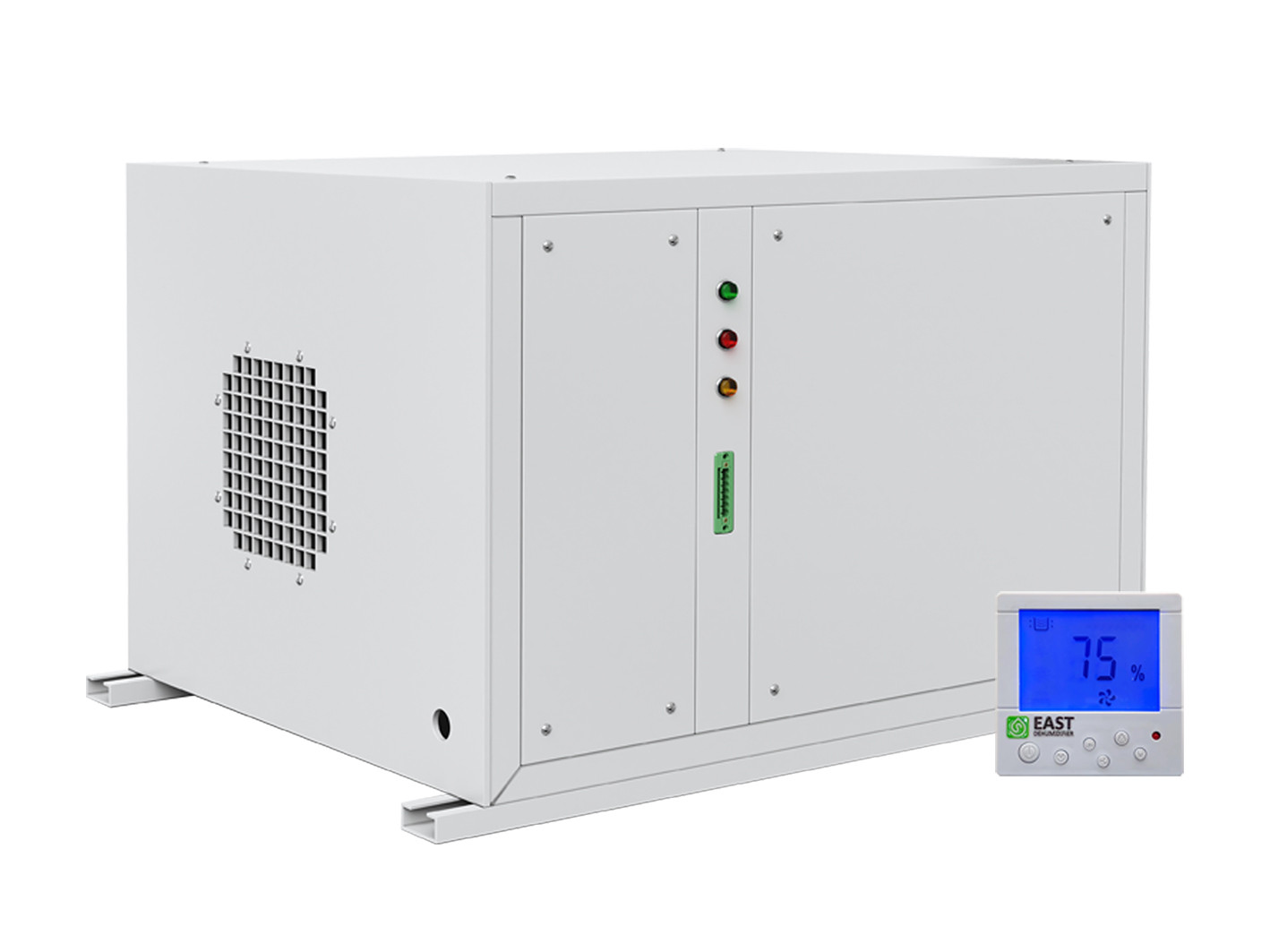
Four sources stack up in a ceiling unit. The compressor contributes the tonal part, the fan contributes broadband noise that rises steeply with airflow, the discharge grille adds air noise where velocity is highest, and the fixings turn cabinet vibration into ceiling structure noise. The last one is why a machine quoted at 55 dB(A) can be more irritating in practice than a floor unit quoted at 65 dB(A): it is coupled to a large radiating surface.
Capacity is a good proxy for the total. Published ranges for ceiling mounted ranges put 20–50 L/day models at 45–50 dB(A), 90–130 L/day at 50–55 dB(A), and the 168–720 L/day three-phase frames at 68–75 dB(A) with airflow from 2,000 to 8,000 m³/h. Airflow is the variable to watch, not litres per day.
Read the figure before you trust it. Manufacturer numbers are A-weighted sound pressure levels, usually measured at 1 m in a free field; some datasheets quote at 3 m instead, which is worth roughly 9–10 dB less under the inverse square rule. A 49 dB(A) figure at 3 m and a 55 dB(A) figure at 1 m can describe very similar machines. A-weighted numbers also under-report low-frequency hum, which is what occupants in quiet rooms actually complain about.
Three rules help when comparing: sound pressure falls about 6 dB for each doubling of distance in a free field, 3 dB is a doubling of sound energy, and about 10 dB is heard as roughly twice as loud. So a 3 dB difference between two models is marginal, and a 10 dB difference is decisive.
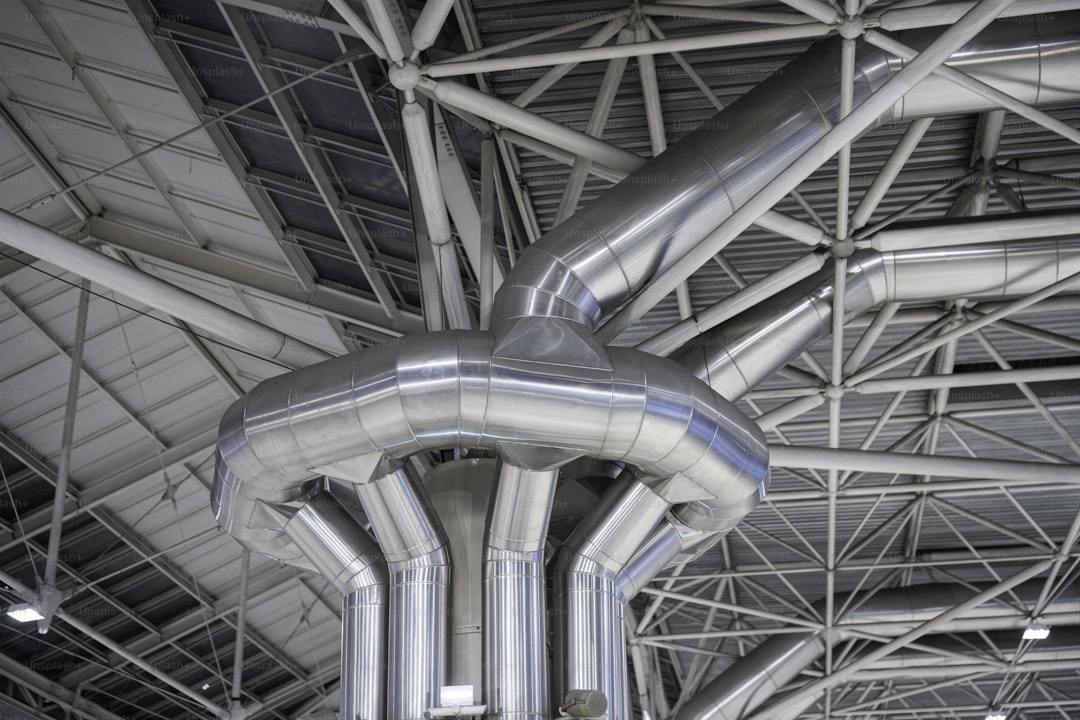
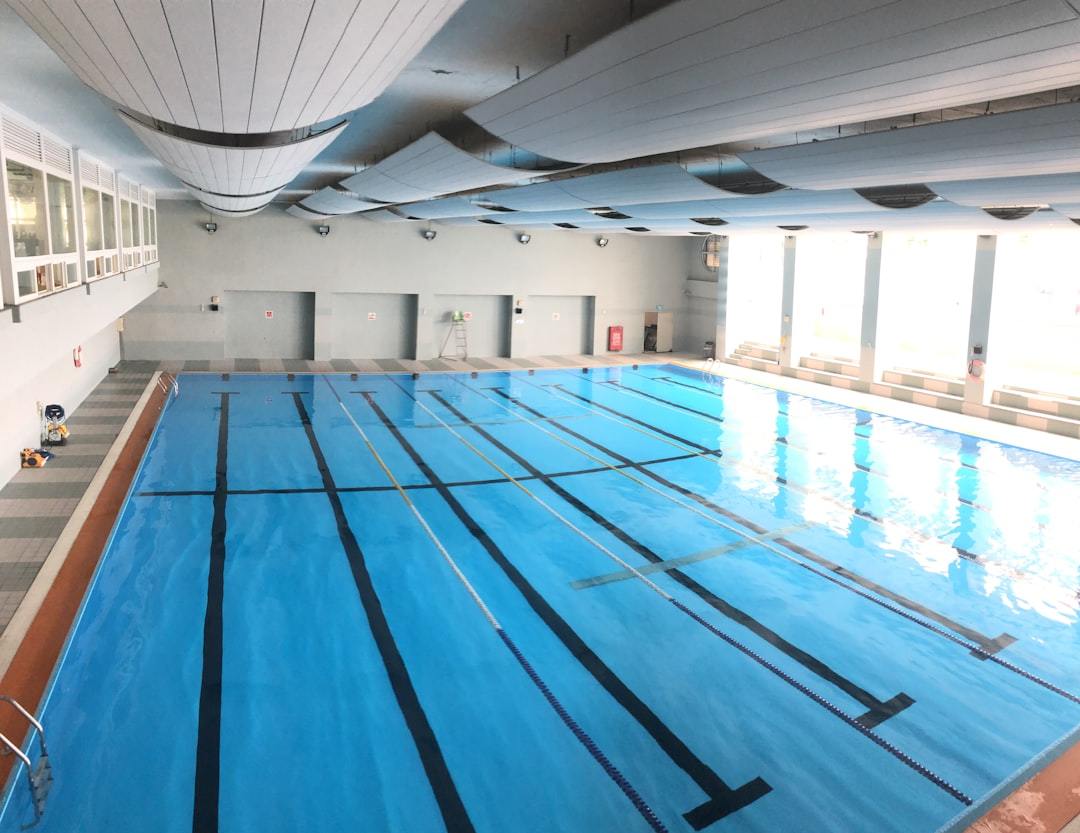
Representative project configuration
An archive wanted 50 ±5% RH with the plant kept out of the storage and reading areas, and the acoustic worry was the reading room directly beneath the service void. Two 90 L/day ceiling units were chosen on capacity and then specified for noise.
Spring hangers, flexible canvas duct collars and a 1.5 m offset from the nearest occupied desk got the reading position into the high 40s, roughly the level of a quiet office. The trade-off is real: isolators and flexible connections add cost and need checking annually, and running the units on a lower fan speed to cut noise also cuts the litres per day.
Capacity, airflow and the noise you should expect
| Capacity band | Air circulation | Typical noise | Where it is acceptable |
|---|---|---|---|
| 20–50 L/day | 150–500 m³/h | 45–50 dB(A) | Offices, archives, small plant rooms |
| 90–130 L/day | 850–1,000 m³/h | 50–55 dB(A) | Corridors, storage halls, pool plant rooms |
| 168–240 L/day | 2,000–2,600 m³/h | 68 dB(A) | Warehouses, workshops, parking structures |
| 360–720 L/day | 4,000–8,000 m³/h | 75 dB(A) | Industrial halls with hearing protection zones |
The table is manufacturer catalogue data, not a certified measurement, and it is measured in free field rather than in your room: hard surfaces and a low ceiling add reverberant sound on top of it, often by several dB. Two other caveats matter. Defrost cycles and fan-only modes change the level during a run, and dirty filters raise it as static pressure climbs. East Dehumidifier will quote the figure at a stated distance and tell you when the honest answer is to move the unit rather than to quieten it.
Related questions
Noise-sensitive location?
Send room dimensions, ceiling construction, target RH and the nearest occupied position. East Dehumidifier will quote the sound level at a stated distance and specify the mounting that goes with it.