Custom Industrial Dehumidifiers Manufacturer - Delivered in 15 days.

Can one system handle both humidification and dehumidification?
Yes. A combined constant humidity unit holds a single setpoint in both directions, switching between modes across a dead band of about 5 percent RH. Industrial ranges run roughly 90 to 480 litres per day of dehumidification against 3 to 40 kilograms per hour of humidification, with control accuracy around plus or minus 3 percent RH.
How one machine does both jobs
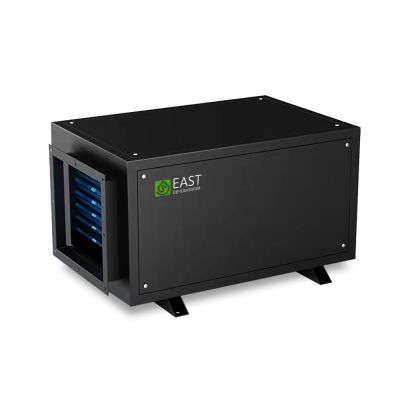
The two functions share a cabinet, one fan, one controller and one discharge, but they are separate systems. Dehumidification runs a refrigeration circuit: air is cooled below its dew point on an evaporator, water condenses out, and the air is warmed again across the condenser. Humidification on these units is usually wet-media evaporation or ultrasonic atomisation, with water taken from an onboard tank of 22–50 litres fed through filtration.
The controller reads room RH continuously and decides direction. With a 50% setpoint and a 5% dead band, it dehumidifies above about 55% and humidifies below about 45%, and idles with the fan running slowly in between. That dead band is not a defect — without it the two systems would cycle against each other and burn energy doing nothing.

The honest limitations matter more than the convenience. First, size each direction to its own worst case. A room that swings from 25% RH in winter to 80% in summer needs a humidifier sized for the winter deficit and a dehumidifier sized for the summer surplus, and both live in one cabinet, so the cabinet is bigger than either machine alone would be.
Second, a condensing combo cannot go deep. Below about 10% RH, or below roughly 15 °C, the refrigeration side runs out of capacity and you need a desiccant rotor for the dry direction. Third, humidification is adiabatic: it draws evaporation heat from the room air, cooling the space by roughly 0.7 °C per gram of water per kilogram of air, which is unwelcome in a room you are also trying to keep warm. And if temperature must be held to a setpoint as well as humidity, a humidity-only combo is not enough.
Representative project configuration
A document store needed 45–60% RH held all year. The building was damp in summer and dried out under winter heating, and the collection was being moved between two machines seasonally, with the gaps causing visible damage to paper.
The plant saved about 40 percent of the floor area of two separate machines and one control system instead of two. The compromise: the humidification side needs a filtered water supply and a drain, so the unit has to sit where both exist — which is usually the reason a ducted ceiling version is chosen over the mobile one.
Combo unit versus two separate machines
| Aspect | Combined unit | Two separate machines |
|---|---|---|
| Floor space | About 40% less | Two footprints, two duct runs |
| Control | One setpoint, one sensor, auto-switch | Two controllers that can conflict |
| Capital cost | Lower than two machines | Higher, but each is a simpler box |
| Depth of drying | Condensing limit, about 10% RH floor | A rotor machine reaches −40 °C and below |
| Redundancy | Single point of failure | One function survives a failure |
| Best for | Archives, labs, data centres, grow rooms | Deep drying plus separate comfort humidification |
Where the room must go very dry, the honest answer is no — one box will not do both, and a combined unit is the wrong specification. A lithium dry room at −40 °C dew point needs desiccant dehumidification, and its humidification requirement, if any, belongs to a different zone entirely. East Dehumidifier will size both directions against your seasonal extremes and tell you when a single cabinet cannot cover the swing.
Related questions
One unit or two?
Send the seasonal swing in RH, room volume and target band. East Dehumidifier will size both directions and say when a single cabinet cannot cover the swing.