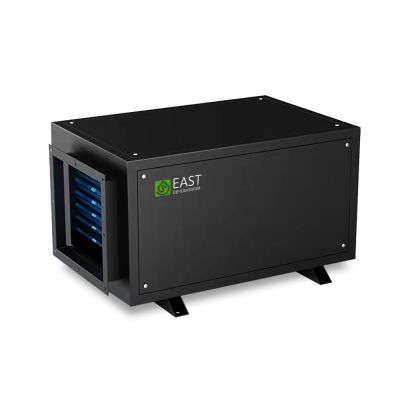
Custom Industrial Dehumidifiers Manufacturer - Delivered in 15 days.

What airflow range does an industrial single unit desiccant dehumidifier cover?
Industrial single unit desiccant dehumidifiers usually span 300 to 3,000 cubic metres per hour of process air and remove roughly 2 to 19 kilograms of water per hour at 20 degrees Celsius and 60 percent RH. Larger rotor frames reach 10,000 cubic metres per hour and about 65 kilograms per hour. Regeneration takes a further 25 to 35 percent of the process airflow.
How airflow, removal and dew point relate
Airflow and water removal are not the same axis, and quoting one without the other is the most common source of disappointment. A machine rated at 3,000 m³/h may remove 6 kg/h at a mild inlet condition and 23 kg/h at a humid one, because removal depends on the humidity ratio difference between inlet and outlet. Always ask which inlet condition the nameplate figure was measured at — 20 °C / 60% RH is the usual reference and it is far milder than a summer plant intake.
The second relationship is between airflow and outlet dew point. At a fixed rotor size, pushing more air through gives a shallower outlet condition. That is why single rotor stages are quoted in bands: roughly −10 to −20 °C for standard silica gel with 110 °C regeneration, −30 to −45 °C for high-capacity media at 120 °C, and −50 to −70 °C only with zeolite or molecular sieve at 180 °C or higher.

Regeneration air is the hidden third stream. It typically takes 25–35 percent of the process airflow and carries all the removed moisture out as vapour rather than liquid. That is why a desiccant unit has no condensate drain, and why the wet air duct has to be insulated, sloped away from the machine and fitted with a drain point: the air inside it can carry a dew point above 30 °C.
The energy side is best tracked as a ratio rather than a percentage. Regeneration energy ratio — heat input per kilogram of water removed — typically runs 4,500–8,500 kJ/kg against a theoretical evaporation minimum of about 2,501 kJ/kg. High-COP rotor systems with heat recovery get below 4,000 kJ/kg, which is the figure to compare between suppliers.
Representative project configuration
A cell production facility specified −40 °C dew point on a closed circulation loop with eight operators. Process airflow was set at 5,000 m³/h, which sits above the standard single unit band and is reached by pairing units or moving to a larger rotor frame.
The outlet was set 5 °C below target as a working margin. Annual consumption broke down as roughly 96 MWh for the process fan, 552 MWh for the regeneration heater at 0.7 average load, and 48 MWh for the regeneration fan — about 696 MWh in total, falling to around 520 MWh with regeneration heat recovery fitted.
Typical single unit ranges by frame size
| Frame | Process airflow | Removal at 20 °C / 60% RH | Typical duty |
|---|---|---|---|
| Compact | 300–800 m³/h | 2–6 kg/h | Cold stores, packaging rooms, small labs |
| Mid | 800–2,000 m³/h | 6–12 kg/h | Food drying, pharmaceutical suites |
| Large | 2,000–3,000 m³/h | 12–19 kg/h | Battery sub-assembly, cleanroom make-up |
| Extended rotor frames | 3,000–10,000 m³/h | up to about 65 kg/h | Full dry rooms, multi-zone plants |
Whole rotors are catalogued from about 100 to 25,000 m³/h per single rotor, so the cabinet frame rather than the rotor is usually what limits a "single unit" machine. Above roughly 3,000 m³/h, or below about −40 °C outlet, the practical answer is two units in parallel or a two-stage arrangement. East Dehumidifier will state the removal figure at your actual inlet condition rather than the reference condition, because the gap between the two is where undersized plants come from.
Related questions
Choosing a frame size?
Send process airflow, inlet condition and outlet dew point target. East Dehumidifier will quote removal at your actual inlet condition, not at the reference condition.