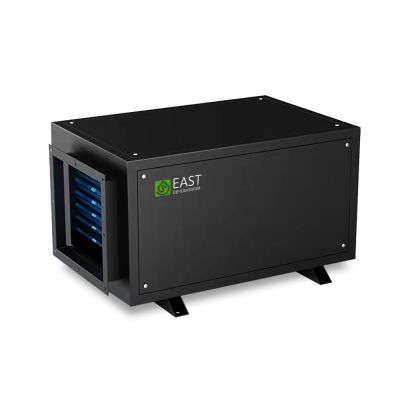
Custom Industrial Dehumidifiers Manufacturer - Delivered in 15 days.

What maintenance does a floor stand dehumidifier need and how often?
Weekly: clean the air filter and check the drain. Monthly: inspect both coil faces and listen for fan or compressor changes. Quarterly: tighten terminals, clean the fan blades and measure compressor current against the nameplate. Annually: refrigerant performance check, deep coil clean and sensor verification. A neglected machine can lose up to 30% of its capacity.
What each interval is actually protecting
Maintenance on a condensing dehumidifier is mostly airflow management. Everything from the return grille to the coil depends on air moving at the designed rate: restrict it and the coil runs colder, the compressor runs longer, and the unit ices even in a warm room. That is why the filter is the highest-value item on the list and why weekly may not be often enough in a dusty or fibrous environment.
The second theme is water. The drain pan, the hose and any pump are the parts that fail without warning, and the failure mode is damage to the building rather than to the machine. Checking that water is actually leaving takes thirty seconds and prevents the most expensive outcome on the list.
The third theme is evidence. Comparing the controller reading against an independent hygrometer once a month catches sensor drift early, and logging it builds the record a quality or audit system will ask for.
The limits worth knowing
None of this is a substitute for a refrigeration engineer. Anything inside the sealed system — refrigerant charge, compressor health, leak detection — belongs to a qualified technician, and opening a live cabinet is not an operator task. Everything outside that boundary is cheap to do badly and expensive to skip.

Representative project configuration
A distribution warehouse holding temperature-sensitive stock needed documented humidity control across two mapped zones. Filters were loading quickly because the building sat next to a busy loading yard.
The only change from the standard schedule was shortening the filter interval to match the dust load. East Dehumidifier recommends setting intervals from the environment rather than the calendar, then tightening them where a filter is visibly loaded before its due date.
Maintenance schedule at five intervals

| Interval | Tasks | Typical time | Who |
|---|---|---|---|
| Daily or per shift | Check alarms and mode, compare room RH with target, confirm condensate is flowing, listen for new noises | 3–5 min | Operator |
| Weekly | Clean or replace the air filter, inspect drain pan and hose, look for early frost or fouling on the coil face | 15–20 min | Operator |
| Monthly | Clean both coil faces, check fan blades and rotation, test any condensate pump, cross-check RH with an independent meter | 30–45 min | Site technician |
| Quarterly | Tighten electrical terminals, check mounts and isolators, inspect accessible refrigerant lines, measure compressor current against the nameplate | 1–2 h | Technician or electrician |
| Annually | Full coil clean, refrigeration performance check, compressor review, humidity sensor verification, electrical safety inspection | Half day per unit | Specialist |
Intervals are environmental, not calendar-based. In a high-dust site move filter checks forward; in a corrosive site inspect terminals and cabinet seals more often; in low-temperature duty watch airflow closely, because icing usually starts with restricted air rather than with low temperature alone.
Related questions
Want a maintenance plan for your site?
Send the number of units, the environment and who will service them. East Dehumidifier will return an interval schedule matched to your dust load rather than a generic calendar.