Custom Industrial Dehumidifiers Manufacturer - Delivered in 15 days.

Floor stand vs ceiling mounted dehumidifier: which saves more space?
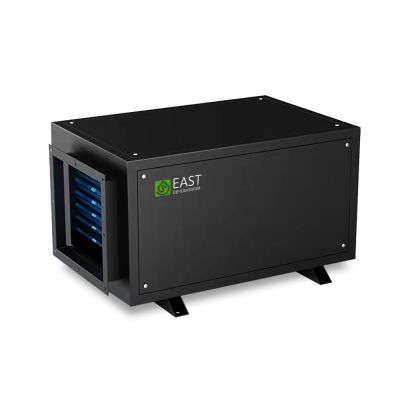
A ceiling mounted unit saves the floor: it uses zero square metres of working area, while a floor standing machine occupies 0.35–0.7 m² plus service clearance. The trade-off is installation. Ceiling units need structure, drainage and a power feed at height; floor units plug in and can be moved. Choose ceiling when floor area is scarce or ducted distribution is needed, and floor standing when you want capacity, mobility and the lowest installed cost.
How the two mounting styles differ
Floor space
Ceiling units sit above the work zone, so aisles, racking and forklift routes stay clear. A floor unit needs a permanent parking spot with 300–500 mm clearance on the air inlet side.
Air distribution
Supplying dry air from height gives more even mixing in high-bay spaces and avoids the short-circuiting that happens when a floor unit discharges straight back towards its own return.
Installation
Ceiling work needs structural fixings, a condensate line with at least 1% fall or a pump, and power at height. Floor standing units need a level slab and a socket.
Service access
Filters and coils on a floor unit are reached at waist height. A ceiling unit must be planned with an access panel or walkway, otherwise routine filter cleaning becomes a scaffolding job.
Where each one earns its keep
Electronics cleanrooms, pharmaceutical packing halls, underground car parks and finished basements are classic ceiling cases: the floor is fully committed to production or parking, and the humidity load is permanent. In these buildings the unit disappears into the void and dry air is distributed through short duct runs.
Warehouses, workshops, plant rooms and construction sites are the opposite. The floor is already concrete, the layout changes every season, and the same machine may be needed in a different bay next quarter. A floor standing unit also carries more capacity per casing, because it is not limited by what a ceiling structure can hang.
The limits worth knowing
Mounting position does not make a dehumidifier more efficient by itself. Efficiency still comes from the refrigeration circuit, airflow and operating point. A ceiling unit only gains an advantage when its position genuinely improves air distribution. There is also a hard ceiling on size: most single ceiling casings top out well below the largest floor standing frames, so very high moisture loads still end up on the floor or in a ducted plant room.
Representative project configuration
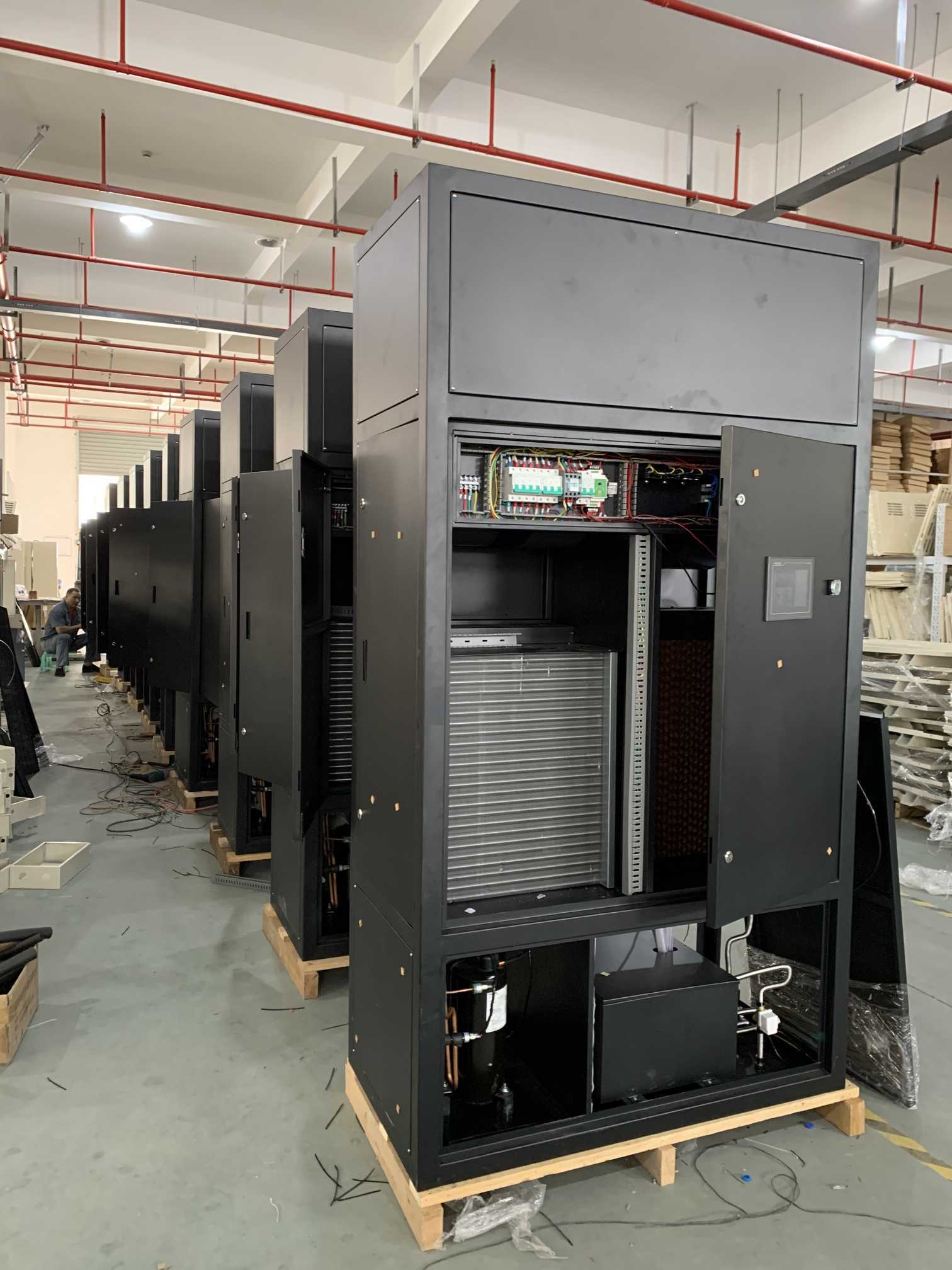
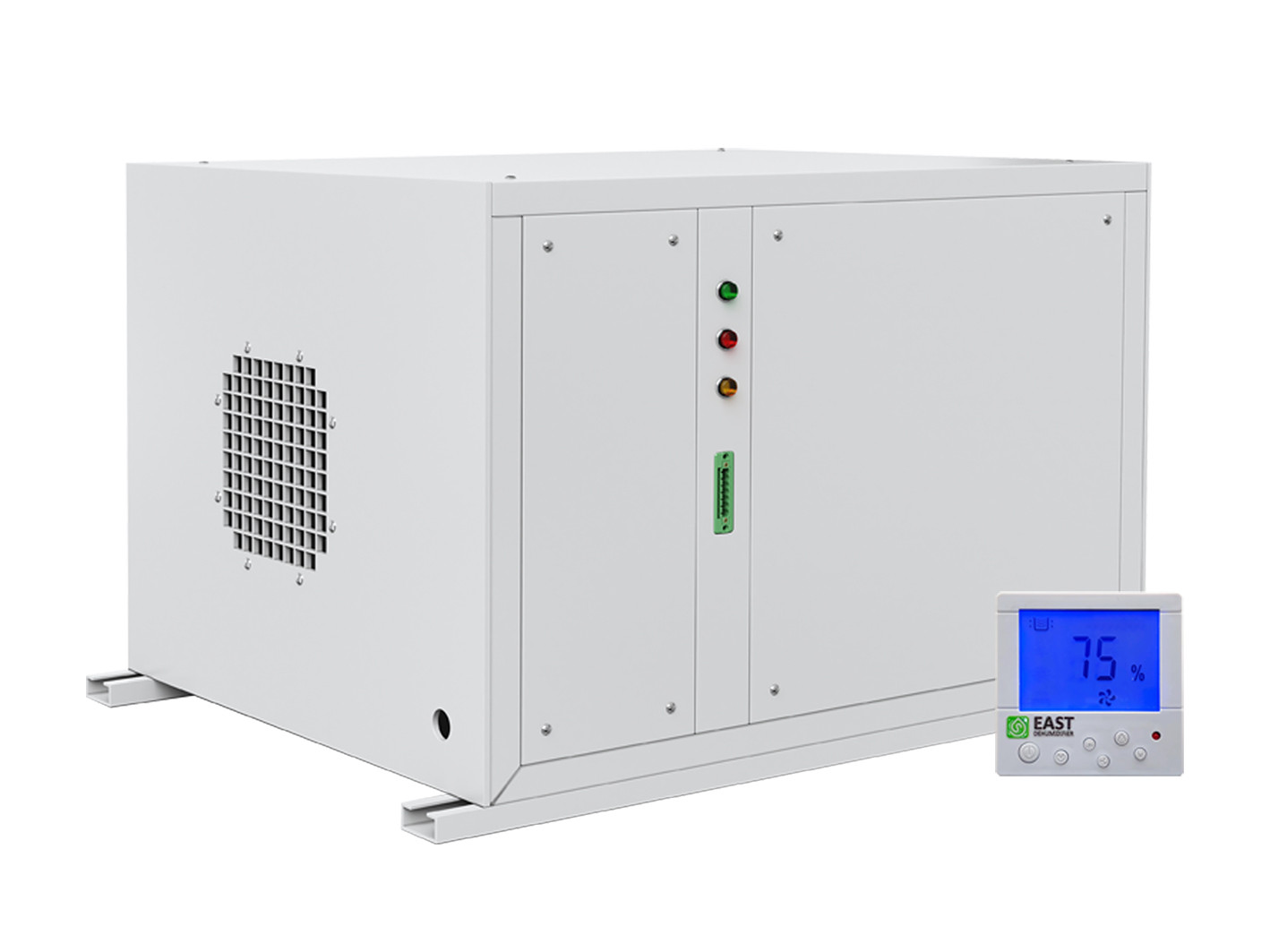
A PCB assembly hall needed 50% RH for static control, but every square metre of floor was taken by lines and trolleys. Two floor units had already been parked in an aisle and were causing a traffic bottleneck.
Units were hung at 3.0 m on vibration isolators, drained to a common gravity header, and set to a 50% RH setpoint with a 5% dead-band. An access panel was left below each filter. Figures are configuration-based; structure, ducting and voltage all move the final number.
Ceiling versus floor standing, in numbers

| Criterion | Ceiling mounted | Floor standing |
|---|---|---|
| Floor area consumed | 0 m² | 0.35–0.7 m² per unit |
| Typical mounting height | 2.4–3.5 m | Floor level |
| Single-unit capacity band | Small to medium | Medium to very large |
| Installation work | Structure, drain, power at height | Plug-in, hose to drain |
| Relocation | Effectively fixed | Moved with a pallet truck |
| Filter service | Needs planned access | Waist height, direct |
| Best fit | Permanent control, tight floors | High load, seasonal, changing layouts |
Selection shortcut: if the humidity problem is permanent and the floor is worth more than the installation, go ceiling. If the problem is seasonal, the layout moves, or the moisture load is heavy, stay on the floor. East Dehumidifier builds both, so the answer comes from the site survey rather than from a catalogue preference.
Related questions
Deciding between ceiling and floor mounting?
Send floor area, ceiling height, current and target RH, and a layout note. East Dehumidifier returns a mounting recommendation with capacities.