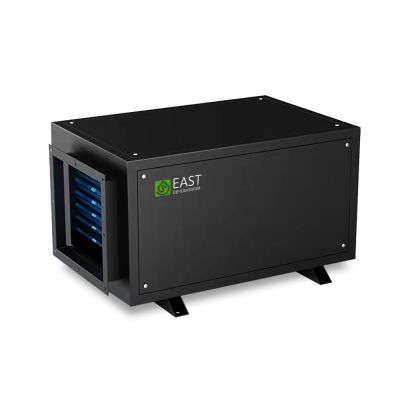
Custom Industrial Dehumidifiers Manufacturer - Delivered in 15 days.

How does a split dehumidifier control humidity and temperature at the same time?
A split dehumidifier runs two independent control loops. The refrigeration circuit removes moisture by cooling air below its dew point, then a reheat stage restores the temperature the room actually needs. Because the reheat section is part of the same machine, the unit can dry without cooling the space, cool without over-drying, or hold temperature steady and move only the humidity.
The control sequence, step by step
Sense
Return-air sensors read dry-bulb temperature and relative humidity, or dew point in tighter applications, and compare them with both setpoints.
Cool below dew point
The evaporator pulls the air under its dew point. Water condenses on the fins and drains away. This is the only step that removes moisture.
Reheat to setpoint
Heat recovered from the condenser, or an additional coil, lifts the air back up, typically 3–6 °C, before it is discharged.
Modulate
Capacity is trimmed by inverter compressor speed, fan speed or reheat staging, so the unit follows the load instead of cycling on and off.
Why the reheat stage is the whole point
Dehumidification and cooling are physically the same operation: cool the air and water falls out. The problem is that a room rarely wants both at the same time. A pool hall wants 28 °C and 55% RH; a lithium store wants cool and very dry; an archive wants stable temperature with a narrow humidity band.
Without reheat, the only way to dry a room is to keep cooling it, which is why conventional air conditioning leaves spaces clammy and cold. With reheat, the machine decouples the two variables: the evaporator sets how much water comes out, the reheat stage sets the delivery temperature, and the two are independent.
Practical limits
Reheat costs energy, so constant-temperature mode is always more expensive per litre than plain cooling mode. The condensing floor still applies: below about 15 °C capacity drops and below 5 °C the coil ices, so none of this works in a cold store. And because drying depends on air passing over the coil, very tight humidity bands need steady airflow rather than intermittent fan operation.

Representative project configuration
An instrument assembly room needed 22 °C and 50% RH with narrow drift. A standard air conditioner reached the temperature but left the room swinging between 55% and 72% RH depending on the weather.
The unit ran in constant-temperature mode with dew-point feedback and a 4% dead-band. Achievable tolerance depends on envelope tightness, internal gains and door traffic; a leaky room will not hold these figures.
Mode-by-mode behaviour
| Mode | Air leaves the coil | Room effect | Relative energy cost |
|---|---|---|---|
| Cooling plus dehumidification | Cooler and drier | Temperature and RH both fall | Lowest per litre |
| Constant-temperature dehumidification | Same temperature, drier | Only RH falls | Moderate, reheat is running |
| Heating plus dehumidification | Warmer and drier | Temperature rises, RH falls | Moderate, heat is recovered |
| Ventilation only | Unchanged | Air change without moisture removal | Fan power only |
Control tip: in precision rooms control on dew point rather than relative humidity. RH moves with temperature, so a sensor reading 50% RH at 22 °C reads a different moisture content at 25 °C. Dew point is the stable variable, which is how East Dehumidifier configures the control loop on precision split systems.
Related questions
Need independent temperature and humidity control?
Send target temperature, target RH, room volume and internal heat gains. East Dehumidifier will specify the reheat and control arrangement.