Private Label Dehumidifiers: A Step-by-Step Guide to Building Your Own Brand Line
You do not need your own factory to own a dehumidifier brand. Some of the most recognised names on the market — including international leaders like Bry-Air, founded in the United States in 1964 and now running manufacturing and subsidiaries across China, Malaysia, Brazil and beyond — sell products built through exactly the same contract-manufacturing model a small distributor uses. The difference between them and you is process, not access. This guide walks through the seven steps that turn a blank brand into a working private-label line, and flags the one decision most suppliers are reluctant to explain in writing: who actually files, pays for and owns the certifications.
1. Step 1: Pick Your Starting SKUs
A first private-label line should be two to four SKUs, not twenty. The goal of your first order is to validate that the product sells and that the supply chain holds — not to open a category. Choosing the right starting SKUs comes down to three decisions.
Choose a platform, not a blank page
The cheapest and fastest private label is built on a factory’s existing platform — a model already in production, with tooling paid for and a known failure rate. Starting from a blank design means new molds and new validation, which moves you from weeks to months and multiplies cost. A near-standard unit allows a lower MOQ; changing the colour, control panel, plug type or performance spec pushes the minimum upward, because every change consumes factory material, labour and scheduling.
Match capacity and voltage to one market first
Pick a single target market and spec for it. North America means 110–120V/60Hz and a US plug; Europe means 220–240V/50Hz with the appropriate certification path. Decide your capacity tier early — compact residential units (roughly 10–20 L/day), commercial units (50–100 L/day and up), or industrial/desiccant units — because the platform, compressor and refrigerant all follow from it. Splitting your first order across several voltages is how budgets quietly double.
| Factor | Lower-MOQ scenario | Higher-MOQ scenario |
|---|---|---|
| Product structure | Standard existing platform | New shell or new internal layout |
| Branding | Logo print only | Custom colour box, manual and labels |
| Electrical spec | Existing factory version | New voltage, plug or certification path |
| Packaging | Generic export carton | Fully branded retail packaging |
How each customization lever moves the minimum order quantity. The more you depart from the factory’s existing platform, the higher the MOQ tends to go.
What the market shows: published MOQs vary widely by factory and customization level — from a single trial unit or a 2-piece sample at one end, to 50 pieces for OEM work or a full 40′HQ container at the other. Treat any headline MOQ as negotiable once you specify exactly what you are changing.
2. Step 2: Appearance, Color and Logo Customization
This is where a factory unit becomes your unit. Cosmetic customization is the highest-impact, lowest-cost work in private label — but only if you know which changes are cheap and which ones hide a mold.
What changes cost almost nothing
Logo application, nameplate, rating-label artwork, packaging design and a colour match from the factory’s existing palette are all low-cost. Independent sourcing guidance puts cosmetic setup — a custom injection-molded colour or a special display — in the US$500–1,500 range, and some suppliers charge a one-time OEM customization fee of a few hundred US dollars per model. These are the levers that make a shared design feel exclusive.
What changes cost real money
A completely new casing is a different story. A new plastic injection mold for a standard 50-pint residential dehumidifier typically runs US$15,000–25,000, and a moulded shell tool quoted by Chinese specialists at around US$10,000 would cost US$150,000–300,000 to tool in industrialised countries, with a rated life of 500,000 to 1,000,000 shots. If you pay for tooling, the manufacturing agreement must state that the mold is yours — and register your trademark in China before production starts, so exclusivity is written down, not assumed.
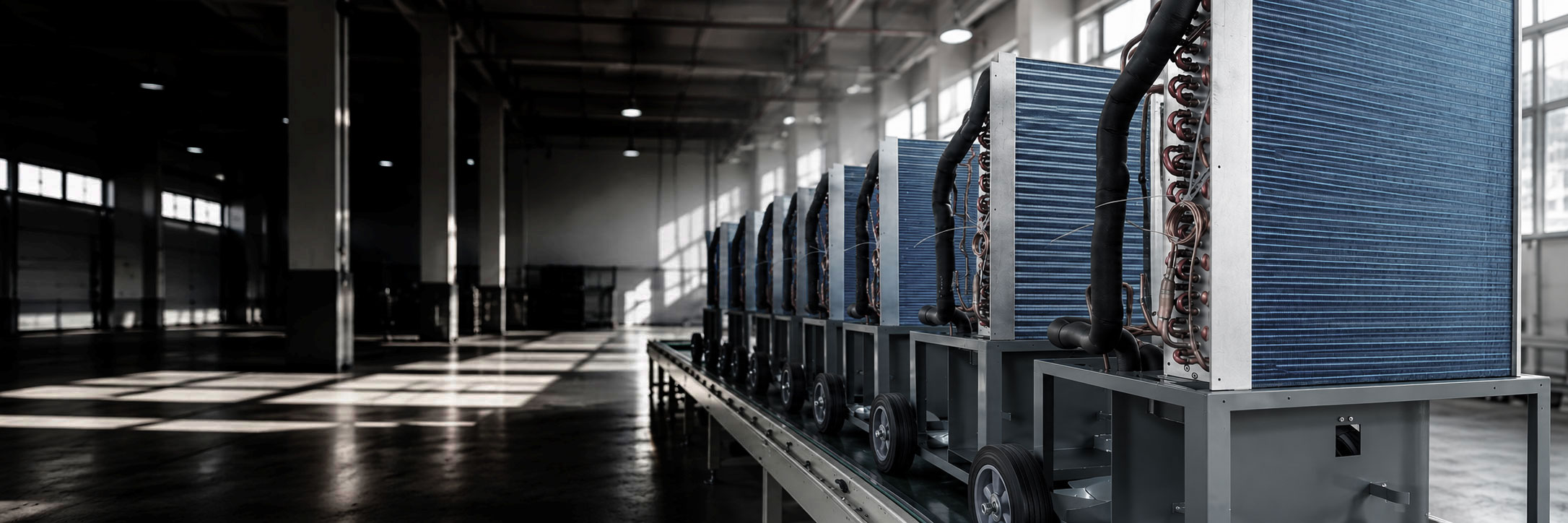
Customized units on the production line — branding, colour and panel changes happen on the same line that builds the standard models.
3. Step 3: Certifications — Who Files, Who Pays
This is the section most suppliers will answer vaguely, because the honest answer shifts responsibility onto you. Get it right and a certification becomes an asset you own; get it wrong and you are buying access to a market under someone else’s name.
The legal “manufacturer” is not who builds it
Under EU law, the manufacturer is the party that places a product on the market under its own name or brand — “make it yourself, or have it made for you and sell it under your own name.” That is you, the brand owner, even though the factory assembled every unit. For a CE-marked dehumidifier this means the EU Declaration of Conformity (DoC) is signed by your brand, not by the factory — and non-EU brands must appoint an EU authorised representative. The DoC must be translated into the local language of the selling country and kept for 10 years.
Two ways to structure certification
The dehumidifier compliance set is concrete: for Europe, CE under the Low Voltage Directive 2014/35/EU and EMC Directive 2014/30/EU, tested to EN 60335-1 and EN 60335-2-40, typically taking a few weeks; for North America, UL 60335-2-40 (the current standard, which replaced the older UL 474 for new filings) or CSA C22.2 No. 142 / ETL, plus DOE energy rules for the US and ERP Lot 20 for Europe. A full UL listing — test, file, initial factory inspection and annual follow-up — commonly takes three to six months and can run into the tens of thousands of US dollars, whereas a simpler UL test report for an online marketplace clears in weeks.
| Arrangement | Who files | Who owns the cert | Trade-off |
|---|---|---|---|
| Factory files under its name | Factory | Factory | Fastest and cheapest; you depend on the factory staying certified |
| Brand files under its name | You (brand) | You | You own market access and can switch factories; slower and pricier |
| Shared / co-listed | Joint | Shared | Middle ground; contract must define who renews and pays |
Certification arrangements compared. Whoever owns the certificate owns the market access — this is the point that decides your leverage later.
Why this matters to buyers: certification is market access, not decoration. One 2026 sourcing report attributes more than 40% of rejected shipments in 2025 to non-compliant electrical components. Decide who files and who pays before you order, and confirm the supplier can produce the actual DoC and test reports — not just a logo on a brochure.
4. Step 4: Packaging and Manual Localization
Packaging and the user manual are the two things your customer actually touches — and the two things that most often fail a customs inspection or a platform review.
Carton, colour box and the print plate
A generic export carton is cheap but unbranded; a full retail colour box turns the same unit into a product that can sit on a shelf. Colour-box printing usually carries a one-time print-plate fee — some suppliers fold it into the unit price — so ask up front whether that plate is reusable on future orders. Start with a plain carton and a well-designed sleeve or label if cash is tight; upgrade to a rigid colour box when a SKU proves itself.
Manuals and rating labels that keep you legal
The manual must be in the language of the destination market and carry the safety, disposal and contact information local rules require. The rating label must show your brand name, model and the importer’s details where the market demands it. For the EU, the DoC must accompany the product and the importer keeps a copy for 10 years — so packaging, manual and legal documents are one package, not three separate afterthoughts.
5. Step 5: After-Sales and Spare Parts System
A private-label brand lives or dies on what happens after the box is opened. The warranty you print on the box is a promise — your supplier has to be willing to keep it.
Warranty terms to lock in
A 12-month warranty covering manufacturing defects is the industry norm, and reputable factories support it with free spare parts during the warranty period plus remote troubleshooting and video guidance. Some go further and ship a spare-parts allowance — around 0.5% of the FOB quantity — with the order so your local team can repair without waiting on a courier from China.
Spare parts availability over time
Ask how long critical parts stay available after the model is discontinued. The better factories commit to keeping spares in production for five to ten years, which is the difference between a brand your customers trust and a brand they abandon after the first season. Decide the split early: who handles returns, who provides technical support, and who ships the replacement part.
| Responsibility | Typical factory commitment | What you should verify |
|---|---|---|
| Warranty | 12 months on manufacturing defects | Written terms, not a sales promise |
| Spare parts | Free during warranty; 5–10 yrs availability | Which parts, and the reorder lead time |
| Technical support | Remote troubleshooting, video guidance | Response time (e.g. within hours) |
| Spares allowance | Often ~0.5% of FOB quantity | Included or priced separately |
The after-sales model you should negotiate before the first order, and what to ask for in writing.
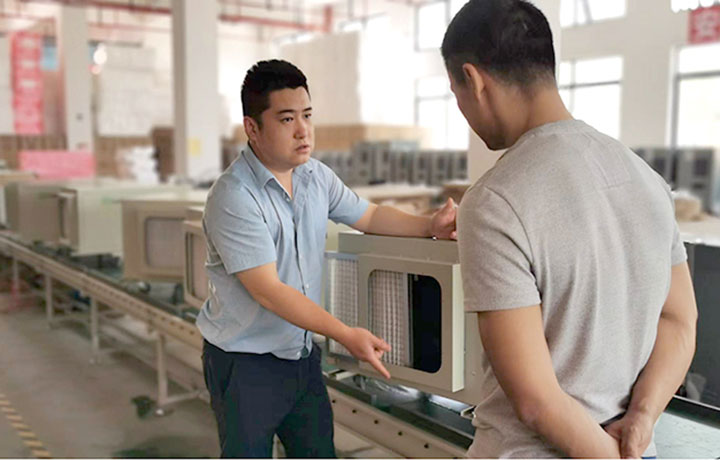
Inside the factory floor — the same assembly, testing and quality stations that back a private-label warranty.
6. Step 6: First Order and Market Test
Do not open with a container. The de-risked path is a sequence, and each step gives you a cheap exit before the money gets serious.
Start with a trial, not a container
Order a sample or a small trial run first — a genuine OEM/ODM factory can usually start at a single unit or a handful, because the fixed cost sits in tooling and setup rather than a minimum batch. Run the unit against its rating before you commit volume: capacity, power draw and noise should match the spec sheet, not just the brochure. Payment terms are typically 30% deposit with 70% before shipment, or L/C for larger orders.
Golden sample and pre-shipment inspection
Lock a golden sample — a production-representative unit you approve and document every detail against — then require third-party pre-shipment inspection on the trial batch. If the supplier resists either, treat it as the single clearest red flag there is. Only after the trial ships, sells and survives its first returns do you scale.
7. Step 7: Scaling the Line
Once the first SKUs prove out, scaling is not just “ordering more.” It is a shift from borrowed designs to owned designs, and from one market to several.
From shared design to exclusive design
Growth moves you from ODM — a shared factory design you private-label — toward OEM — a design you own, with exclusive tooling and your own IP. That transition is exactly where the established players live. Bry-Air, for example, operates a portfolio of manufacturing and subsidiary sites across China, Malaysia, Brazil, Nigeria, Switzerland and the United States serving more than 80 countries, while Sweden-headquartered Munters leads global dehumidification revenue at roughly a third of the market. Both demonstrate the end state: exclusive designs, deep certification coverage and long spare-parts commitments, built on the same factory model a private-label brand starts from.
Register, then expand
Register your trademark in each new market before you ship there, add certifications market by market rather than all at once, and widen the line only as each SKU proves demand. A private-label line compounds: every unit sold is advertising for the next one, and every market you open is a moat your supplier relationships make harder to copy.

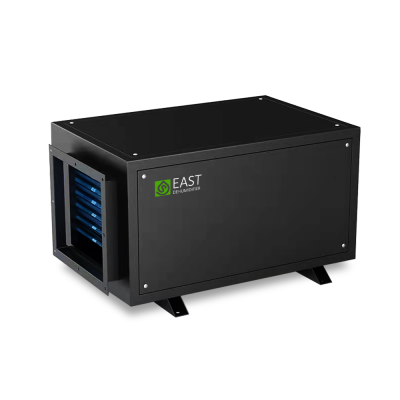
A finished unit — the endpoint of a private-label line, built to your spec and your brand.
If you are planning a private-label line and want the spec, certification and after-sales structure handled properly, start with our customized service page and the EAST service FAQ.