GMP Cleanroom Humidity: How to Hold ±0.5°C and ±5% RH
In a pharmaceutical cleanroom, humidity is the control you cannot see failing. A temperature or particle excursion trips an alarm. A slow humidity drift does not — until a batch of hygroscopic tablets cakes, an effervescent sachet fails, or a capsule line starts sticking. Holding ±0.5°C and ±5% RH is not a luxury; it is what separates a validated facility from a recall. This guide explains how to reach those bands — and keep them there.
1. Why GMP Sets Such Tight Bands
GMP does not dictate a single humidity number for every room. It requires the manufacturer to define and hold the conditions a product needs, then prove control with data. That is the whole point of the tighter bands: consistency, not a one-time pass.
Humidity touches drug quality in three concrete ways:
- Chemical stability. Many active pharmaceutical ingredients (APIs) are hygroscopic. Moisture uptake accelerates hydrolysis and degradation, shortening shelf life and changing potency. Effervescent formulations are especially unforgiving — the acid–base couple reacts with any water vapour present during tabletting and packaging.
- Physical integrity. Powders cake and stop flowing in hoppers and dies; gelatin capsules soften and stick; sugar-coated and film-coated tablets turn tacky. Bry-Air, whose desiccant units are widely used in pharmaceutical powder and capsule lines, lists "moisture regain" as a leading cause of sticky, non-flowing material in tablet and vitamin production.
- Microbial control. Above roughly 60–65% RH, mould and bacteria find conditions to grow. In a sterile environment, a humidity excursion is therefore also a contamination risk, not just a quality one.
This is why the design code treats humidity as a process parameter, not a comfort setting. The band is narrow because the failure modes are expensive.
2. Graded Dehumidification: The Core Idea
The single biggest mistake in cleanroom humidity design is trying to pull one big unit down to one dew point and push it everywhere. Effective cleanroom dehumidification is graded: remove the bulk moisture first, then trim.
Stage one — bulk removal on fresh air
Outside air is where the load lives. A humid summer day in many manufacturing regions carries 12–20 g/kg of moisture. Fresh air is therefore pre-dried — typically with a desiccant rotor or a chilled-water pre-cooling coil — before it ever reaches the room. Pre-drying the makeup air removes the dominant load at its source, so the in-room equipment only has to manage residual and internal loads.
Stage two — room-level control
Inside the cleanroom, return air carries internal moisture from people, washdown, and process. A dedicated unit keeps the room at its setpoint, reacting to excursions rather than fighting the weather directly.
Stage three — temperature trim
Only after the air is dry do you trim temperature precisely (see Section 4). Grading the work this way gives you two things: tighter control at each step, and far lower energy use than one oversized machine doing everything.
For a full walk-through of how this is engineered for a specific facility, see our biopharmaceutical temperature and humidity control solution.
3. Desiccant Wheel as the Workhorse
When the target is 45–60% RH — or lower, for dry-room and powder-handling steps — a refrigerant (condensing) unit alone cannot be trusted. Condensing coils stop dehumidifying reliably below about 40% RH, and they ice up as the evaporator approaches freezing. Desiccant rotors, by contrast, remove water vapour by adsorption and keep working across the full range a pharmaceutical cleanroom needs.
Munters, a long-time supplier of desiccant systems, states it plainly: desiccant dehumidifiers are the only technology that reliably maintains the precise, low dew points required in pharmaceutical production and cleanrooms. Their rotor-based units are applied specifically to tablet production, capsule filling, and storage, and are described as a key part of maintaining GMP and FDA compliance.
Bry-Air builds pharmaceutical-grade rotors too. Its P95°X range is marketed squarely at the pharmaceutical sector, with a "G4" rotor that regenerates at a low 95°C, a stainless-steel frame, and an EcoDry media with a neutral pH and antibacterial treatment — points aimed directly at cleanroom hygiene and washdown requirements. The comparison below shows why a rotor, not a coil, sits at the heart of most pharma cleanroom dehumidification.
| Criterion | Condensing (refrigerant) | Desiccant rotor |
|---|---|---|
| Reliable RH floor | ≈ 40–50% RH before capacity collapses | Works to very low dew points (below −20°C where needed) |
| Low-temperature behaviour | Coil icing, needs defrost | No icing; stable output |
| Precise low-humidity control | Poor | Excellent — fine modulation of regeneration |
| Hygiene / cleanroom fit | Wet coil surfaces | Dry media; antibacterial rotor options available |
| Typical pharma role | Pre-cooling, comfort zones | Primary humidity control in process rooms |
One operational point is worth underlining: a desiccant rotor needs regeneration heat, so its energy profile differs from a condensing unit. Modern rotors regenerate at low temperature — Bry-Air's G4 media, for instance, regenerates at about 95°C — and can be paired with heat recovery or waste heat, which is why a well-configured rotor often carries a lower total operating cost than its coil-based alternative on low-humidity duty, despite the extra heat input.
Our desiccant rotor units are engineered for exactly this duty. See the desiccant rotor dehumidifier range for capacities and configurations.
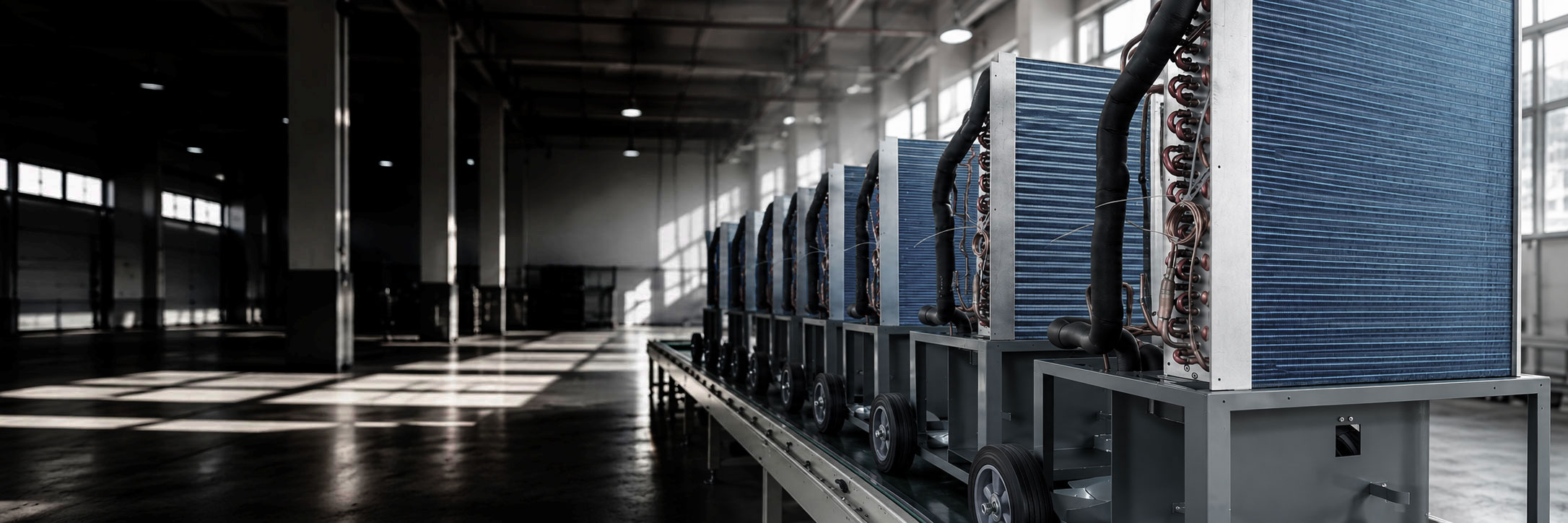
Desiccant rotor dehumidifier units on the production line — the workhorse of pharmaceutical cleanroom humidity control.
4. Temperature Trim: ±0.5°C in Practice
"Hold ±0.5°C and ±5% RH" sounds like one requirement, but it is really two control loops that must be sequenced correctly. The reason is psychrometric: relative humidity is a function of both moisture content and temperature. If you cool air 1°C, its RH rises even though nothing wet was added.
Dew point first, temperature second
The reliable sequence is to control the dew point (the absolute moisture) first, then trim the dry-bulb temperature. When a desiccant rotor fixes the air's moisture content, a downstream precision cooling or reheat coil trims temperature without disturbing humidity. Trying to do both with one coil almost always produces the "see-saw" — temperature corrected at the cost of a humidity spike, then humidity corrected at the cost of a temperature drift.
What ±0.5°C actually demands
A ±0.5°C band is tighter than a standard comfort AHU delivers. It needs a fast-responding control loop, stable chilled-water or DX capacity, and enough air mixing to avoid stratification. High-precision cleanroom specialists quote temperature accuracies down to ±0.5°C and humidity stability of ±5% RH for critical rooms — achievable, but only with the right sequencing and instrumentation.
Where the excursions come from
Door openings, washdown cycles, and process equipment all inject short humidity spikes. A control system that only corrects after the fact will drift. The answer is anticipatory control on the rotor's regeneration plus a small thermal buffer, so the room rides through transients without leaving band.
5. Compliance: GMP and GB 50457-2019
Chinese pharmaceutical cleanroom design is codified in GB 50457-2019, the "Code for design of pharmaceutical industry clean room." It gives concrete temperature and humidity defaults that are widely used as the benchmark across the industry — and by overseas buyers auditing Chinese facilities. When a process or product has no special requirement, the code states:
| Air cleanliness grade | Temperature | Relative humidity |
|---|---|---|
| Grade A, B, C | 20–24°C | 45–60% RH |
| Grade D | 18–26°C | 45–65% RH |
| Storage areas | varies by storage class | 35–75% RH (typical) |
Two points matter for anyone specifying equipment. First, note that the A/B/C band is the tight one — 20–24°C and 45–60% RH — and it is where aseptic filling and sterile processing live. Second, the code also fixes the pressure cascade: at least 10 Pa between rooms of different grades, and at least 10 Pa from cleanroom to outside. Humidity control and pressure control are designed together, because a room that holds pressure but not humidity (or vice versa) still fails inspection.
On the international side, WHO and EU GMP guidance cite the same working ranges — commonly 18–26°C and 45–65% RH for sterile areas — which is why a machine tuned to GB 50457-2019 also slots into FDA and EU GMP projects with minimal adjustment.

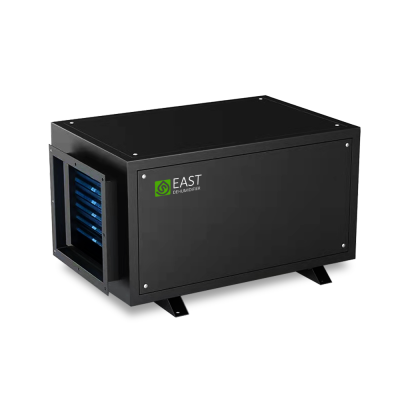
A finished EAST desiccant dehumidifier unit — tuned to the GB 50457-2019 working ranges used across pharmaceutical cleanrooms.
6. Alarm, Logging and Validation
GMP inspectors do not ask "do you control humidity?" They ask "show me the data." That means the dehumidification system must not just hold the band — it must prove it, continuously.
What must be monitored
- Temperature and humidity — continuous, with alarm thresholds on both high and low limits.
- Differential pressure — continuously, because pressure and humidity interact.
- Equipment status — rotor rotation, regeneration temperature, fan and coil operation, filter status.
The validation lifecycle
Facilities are qualified through the familiar DQ → IQ → OQ → PQ sequence. Humidity equipment enters at IQ (installed correctly, wired and instrumented) and OQ (operates within defined parameters), then PQ demonstrates consistent performance under full production load. Environmental monitoring then runs for the life of the facility — HEPA integrity typically re-tested every 6–12 months, particle counts at least annually, and temperature/humidity monitored continuously with alarms and logged data.
What this means for the machine
Buy a dehumidifier without a proper controller, and you inherit the validation burden yourself. The units we specify carry the control and logging points — dew point, RH, temperature, regeneration — so the plant's BMS can trend and alarm them directly. That is the difference between equipment that controls humidity and equipment that survives an audit.
Also worth deciding early: whether you need standalone logging or BMS integration via BACnet or Modbus. A standalone controller is fine for a single room; a multi-room facility is far easier to validate when every unit reports into one trending system with a single time-stamped history. Either way, the data chain — sensor, controller, logger — must be traceable and tamper-evident, because a gap in the history is treated by inspectors as a failure of control, not as a clerical detail.
7. Design Mistakes That Fail Validation
Most humidity-related validation failures are not mysterious. They trace to a handful of predictable design errors:
| Mistake | Why it fails validation |
|---|---|
| Undersized fresh-air pre-drying | Humidity climbs on humid days — the exact condition the inspector will test. |
| One unit, no grading | One oversized machine cannot hold a tight band at part load; it cycles and drifts. |
| Temperature and humidity coupled | The see-saw: fixing one throws the other out of band. |
| No pressure cascade design | Below-10 Pa differentials are a classic FDA 483 observation. |
| No redundancy | A single rotor failure halts a sterile line with no spare capacity. |
| Static-only testing | Passing "at rest" while drifting "in operation" is the most common trap. |
The pattern is the same in every case: the system was specified for a steady state, not for the transient and part-load conditions a real cleanroom actually sees. Specify for the dynamic case — humid weather, doors opening, part-load operation — and the validation falls into place.
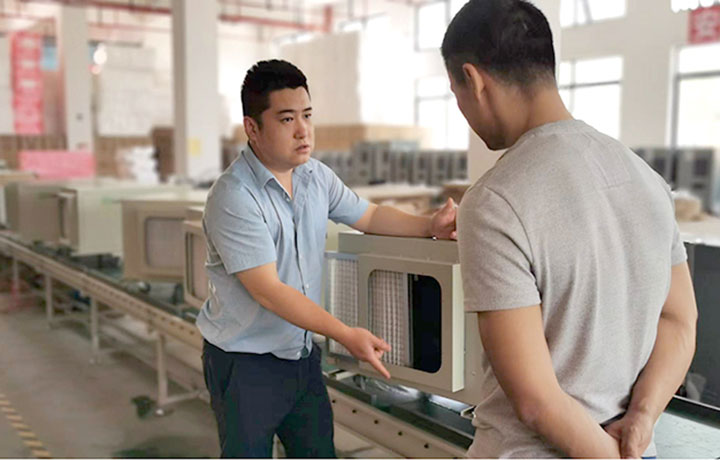
Every unit is factory-run before dispatch, so the equipment arrives already proven against its rated performance.