Desiccant vs Refrigerant Dehumidifiers: The Definitive Selection Guide
The single most expensive mistake in industrial dehumidification is not buying the wrong size — it is buying the wrong technology. Refrigerant (condensing) and desiccant (rotor) dehumidifiers both remove water, yet they fail in completely different places. Choosing correctly comes down to four numbers: your operating temperature, your target relative humidity, your target dew point, and the energy you are willing to spend. This guide lays out the exact dividing lines, the energy curves, and a decision tree you can run against any project — from a warm warehouse to a lithium battery dry room.
1. How Each Technology Removes Water
Before any comparison makes sense, you need to know what physically happens inside each machine — because the mechanism, not the marketing, sets every performance limit that follows.
Refrigerant (condensing): a cold coil and a drain
A refrigerant dehumidifier draws moist air across a cold evaporator coil. When the coil surface drops the air below its dew point, water vapour condenses into liquid and drains away. The now-cooler, drier air passes over the condenser, where it reclaims the latent heat and the compressor’s work before returning to the room slightly warmer. It needs only one utility — electricity — and it produces one byproduct: liquid condensate that must be plumbed to a drain.
Desiccant (rotor): adsorption, then reactivation
A desiccant dehumidifier pulls air through a slowly rotating rotor — a fluted matrix impregnated with silica gel or molecular sieve. Water vapour binds to the desiccant surface by adsorption, and a separate reactivation sector drives the captured moisture back out using a heated airstream, typically at 60–150 °C, which is then exhausted outdoors as warm, wet air. The rotor therefore needs two utilities — electricity plus regeneration heat (electric, steam, hot water or gas) — and one extra byproduct: a ducted exhaust path for the moist reactivation air.
| Attribute | Refrigerant (condensing) | Desiccant (rotor) |
|---|---|---|
| How water is removed | Air cooled below dew point; water condenses | Vapour adsorbed onto silica-gel / molecular-sieve rotor |
| What leaves the machine | Liquid condensate (needs a drain) | Warm, wet reactivation exhaust (needs a duct + heat) |
| Main utility input | Electricity only | Electricity + regeneration heat (electric / steam / hot water / gas) |
| Typical reactivation temperature | — (none) | Roughly 60–150 °C |
| Best-fit environment | Warm, moderate-humidity spaces | Cold spaces, or very low humidity / low dew point |
The two technologies at a glance. Everything downstream — the 40% RH floor, the dew-point capability and the energy gap — follows directly from this mechanism split.
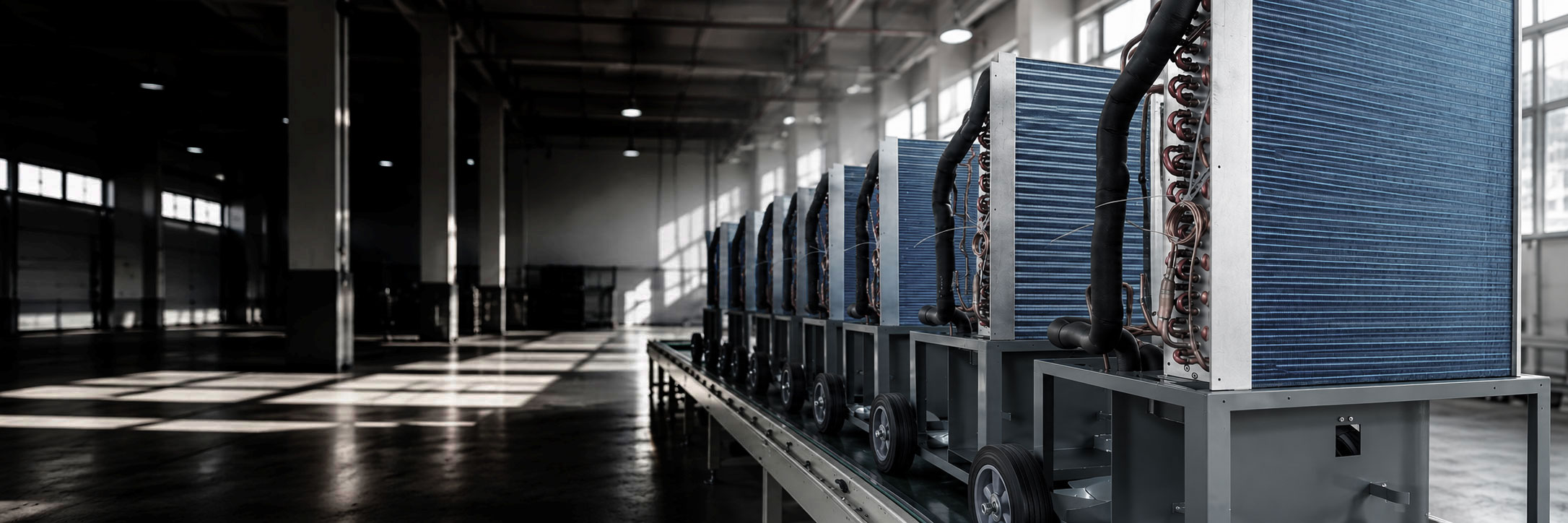
Both technologies come off the same production line. The choice is not about build quality — it is about matching the mechanism to your duty point.
2. The 40% RH Dividing Line
Ask ten engineers where condensing plant stops and you will hear a narrow band: roughly 35–45% RH, with most practical guidance drawing the line near 40%. Understanding why that floor exists turns a rule of thumb into a decision you can defend.
Why a coil has a hard floor
A condensing machine can only extract water while its coil stays colder than the air’s dew point — and as your target RH falls, the required coil temperature falls with it. At 25 °C, 50% RH sits at a dew point of about 14 °C; 40% RH drops it to roughly 10 °C; and 30% RH pushes it near 6 °C. Chasing lower and lower RH keeps forcing the coil toward freezing.
Ice, defrost, and the collapse of capacity
Once the fin surface approaches 0 °C, condensate freezes instead of draining. The machine is forced into defrost cycles, and every minute spent defrosting is a minute the compressor is drawing power without removing water. Below the frost line, useful extraction collapses — which is why published figures put the practical floor for condensing plant at around 35–45% RH under typical industrial conditions.
Adsorption has no such floor. Because the rotor holds water by surface chemistry rather than by cooling, it keeps removing moisture no matter how dry the incoming air already is — down to 1–10% RH. That single difference is why the desiccant rotor wins every deep-dry argument and loses every warm, humid one.
3. Dew Point Capability: -40°C vs +5°C
For many industrial processes, relative humidity is the wrong yardstick. RH swings with temperature, so the same absolute moisture content reads very differently as a room warms and cools through the day. That is why low-dew-point processes — battery drying, pharmaceutical coating, freeze-drying — are specified in dew point, not in percent.
What the numbers actually are
The split is stark. A condensing unit has a lowest useful dew point of roughly +5 °C — in practice nearer +10 °C — because a coil cannot practically be driven below freezing and keep draining. A desiccant rotor reaches -40 °C as a matter of course, and staged multi-rotor systems push to -60 or even -70 °C. As a reference point, at 20 °C a reading of 1% RH corresponds to a dew point of approximately -40 °C.
Why this decides the whole project
If your specification is written as “dew point below +5 °C” or “below 40% RH”, a coil simply cannot reach the target at any energy cost — this is not an efficiency question, it is a physics question. That is exactly why lithium battery dry rooms, pharmaceutical coating suites and confectionery lines specify rotor equipment: they live below the condensing floor.
| Capability | Refrigerant (condensing) | Desiccant (rotor) |
|---|---|---|
| Lowest achievable RH | Roughly 35–45% | Below 1% |
| Lowest useful dew point | About +5 °C | -40 °C (staged to -60 / -70 °C) |
| Control tolerance | Wider band (±10% RH, cycling) | Tight (±2–3% RH) |
| Behaviour at 5 °C ambient | Icing, defrost, poor output | Essentially unchanged |
| Capital cost | Lower | Higher |
Capability comparison at rated conditions. The rotor wins the low-humidity argument and loses the energy argument — the gap between them is the price of reaching a dew point a coil cannot touch.
4. Energy Curves: Where They Cross
Cost of ownership is where the two technologies genuinely trade places, and it is worth separating two different energy stories.
Condensing is efficient — where it works at all
A compressor moves heat rather than creating it, which is inherently efficient. In warm, humid conditions published figures put condensing plant at roughly 0.4–0.6 kWh per litre of water removed — or, expressed the other way, about 1.6–2.6 litres per kWh at 30 °C / 80% RH. On a mass basis that is around 0.5–1.5 kWh per kilogram.
Desiccant pays a regeneration tax
A rotor must heat its reactivation airstream — typically to 120–150 °C — and that thermal load dominates its consumption. The same published comparisons put rotor plant at roughly 0.6–0.9 kWh per litre (about 0.6–1.0 litres per kWh), or 1.0–3.0 kWh per kilogram. In a warm, humid hall a desiccant system can therefore use 30–50% more electricity per litre than a condensing unit doing the same job.
Where the curves actually cross
The comparison flips twice. Below about 15 °C, condensing efficiency collapses into defrost cycles; below about 40% RH, a condensing unit cannot reach the setpoint at any cost. In both zones the rotor is not just more efficient — it is the only option. Two levers narrow the desiccant energy penalty when you must use one: energy-recovery purge (ERP) systems that recycle rotor heat can cut regeneration energy by up to 25–30%, and a hybrid configuration — refrigerant pre-cooling ahead of a rotor — can save on the order of 40% against a pure-desiccant install on large low-dew-point plants.
| Energy metric | Refrigerant (condensing) | Desiccant (rotor) |
|---|---|---|
| Energy per litre removed (warm/humid) | 0.4–0.6 kWh | 0.6–0.9 kWh |
| Removal per kWh (30 °C / 80% RH) | ~1.6–2.6 L/kWh | ~0.6–1.0 L/kWh |
| Energy per kg removed | ~0.5–1.5 kWh | ~1.0–3.0 kWh |
| Regeneration heat | Not required | Required (~120–150 °C) |
| Where it wins | Warm + moderate RH | Cold, or below 40% RH (only option) |
Energy figures are configuration-based and vary with inlet condition — treat them as decision bands, not site guarantees. The trend, not the last decimal, drives the choice.
5. Temperature Range and Cold-Room Behavior
Temperature is the quietest of the four selection numbers, and the one buyers most often forget. It can flip the “right” answer on its own.
The 15 °C and 5 °C lines
Condensing plant is happiest between 15–35 °C. Below 15 °C frost begins to form on the evaporator; below roughly 10–15 °C extraction drops off sharply; and below about 5 °C condensation-based removal essentially ceases. A desiccant rotor, by contrast, holds a nearly flat extraction curve across -20 °C to +50 °C — it does not depend on condensation, so it keeps removing water at 1 °C or in sub-zero freezers.
What a cold room actually looks like
The real-world contrast is best illustrated by low-temperature installations. In one documented cold-store case (KLM Catering, operating at -20 °C), evaporators suffered “ice and snow” and ran “typically six defrosts daily for one hour” each. Switching to desiccant rotor units (Munters IceDry) removed the moisture directly, lengthened the periods between defrosts and cut both refrigeration energy and coil-cleaning effort. In a cold store the comparison reverses: the rotor removes water steadily while a condensing unit spends its day defrosting.
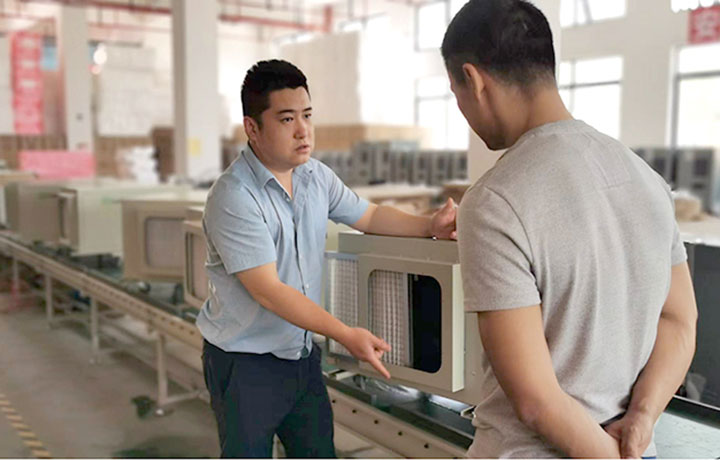
On the factory floor — units built for both warm-hall and cold-room duty, tested against their rated conditions before shipping.
6. The Selection Decision Tree
If you want the whole guide in a form you can hand to a colleague, run these four questions in order. The first “yes” ends the conversation.
Four questions, in order
- Does the space ever drop below about 15 °C? If yes → desiccant rotor (or a low-temperature design review).
- Do you need below roughly 40–50% RH? If yes → desiccant rotor.
- Is the spec written as a dew point below about +5 °C? If yes → desiccant rotor.
- Otherwise (warm space, moderate humidity, no dew-point spec) → condensing.
Size by condition, not by catalogue
Whichever technology you land on, do not select on the headline capacity number. Two rooms of identical volume can have entirely different moisture loads. Bring your supplier six inputs: process airflow, inlet temperature, inlet relative humidity, target humidity or dew point, the moisture generation rate (people, doors, wet product, processes), and the utilities available (electricity only, or heat + an exhaust path). Those six inputs separate a correct selection from a guess, far better than comparing two “litres per day” figures that were rated under different conditions.
7. Six Applications and the Right Answer
To make the decision concrete, here are six common duty points and the technology each one points to — with the reasoning reduced to one line.
| Application | Target | Right choice | Why |
|---|---|---|---|
| General warehousing, cartons, textiles | 45–65% RH, room temp | Condensing | Lowest cost per litre; meets target at lowest lifecycle cost |
| Indoor swimming pool / laundry | Warm, very humid | Condensing | High dew point lets the coil condense huge volumes cheaply |
| Cold store / freezer antechamber | Below 10 °C | Desiccant rotor | Coils ice and stop draining; rotor holds flat output |
| Lithium battery dry room | 1–10% RH, -40 °C dp | Desiccant rotor | Far past the condensing floor; needs deep dew point |
| Pharma coating / confectionery | Below 40% RH | Desiccant rotor | Below the coil’s physical floor |
| Large deep-dry plant (2000 m²+) | Very low dew point | Hybrid (pre-cool + rotor) | Refrigerant pre-treatment cuts rotor load and energy by ~40% |
Six representative duty points. Most ambient-temperature warehouses sit firmly in the condensing column; the rotor takes over wherever cold or deep dryness appears.
The pattern is the same in every row: specify the technology against the actual target, not the other way round. A site that runs a warm hall and a dry room side by side should often buy both technologies — condensing for the hall, rotor for the dry room — rather than over-buying desiccant capacity it does not need.

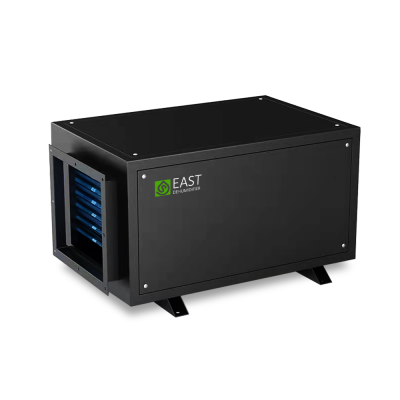
A finished rotor unit ready to ship — specified for the deep-dry duty a coil cannot reach.