Below 40% RH: Why Condensing Dehumidifiers Stop Working (and What to Use Instead)
If you have ever watched a condensing dehumidifier run continuously while the hygrometer refuses to fall below 40% RH, the machine is probably not broken — it has hit a physical wall. Refrigerant dehumidifiers remove water by cooling air down to its dew point on a cold coil, and below roughly 40% relative humidity that dew point drops so low the coil must run at or below freezing. At that point the machine stops removing moisture and starts fighting ice.
The Physics: Why Evaporator Coils Give Up
A condensing (refrigerant) dehumidifier works on one hard rule: the coil surface must be colder than the dew point of the air passing over it, or no water condenses. That single requirement is the entire reason the technology has a floor.
As the air gets drier, its dew point falls — and it falls fast. At a comfortable 25 °C:
- 50% RH → dew point ≈ 14 °C
- 40% RH → dew point ≈ 10 °C
- 30% RH → dew point ≈ 6 °C
To hold 30% RH at 25 °C, the evaporator has to run at or below 6 °C — and the fin surface always sits a few degrees colder than the air's dew point in order to transfer moisture. Once that fin surface approaches 0 °C, the condensate freezes instead of draining, and the machine must stop dehumidifying to thaw itself.
Why drier air is a colder-coil problem
The cooling capacity that a condensing unit spends is split two ways: some goes into lowering the air temperature (sensible), and some goes into condensing vapour (latent). When the air is wet, most of the work is latent — water condenses readily. When the air is dry, the unit keeps pumping cooling into air that has almost nothing to condense, so the coil temperature drops further and further until it crosses the frost line. This is not a fault; it is the physics of condensation itself running out of room.
Frost Formation and the Defrost Spiral
At low humidity the small amount of water condensing on the coil cannot absorb the cooling load, so the coil keeps cooling until ice forms. Frost then does two destructive things at once: it blocks airflow across the fins and insulates the surface, so capacity collapses. The control board responds with a defrost cycle — during which the machine removes no water at all.
The result is a self-reinforcing spiral: drier air → colder coil → frost → defrost → less running time → less water removed → the coil runs colder again. Below a dew point of roughly 10–12 °C, extraction rates become minimal even with a good hot-gas defrost system. Australian distributor AAATEC draws the decision line here: below a 10 °C dew point, specify a desiccant; above 12 °C, a quality refrigeration unit is appropriate.
The 10–12 °C dew point decision line
That threshold translates directly into relative humidity. At 25 °C a 10 °C dew point is about 40% RH — which is exactly why the practical floor of condensing plant is quoted at 35–45% RH across manufacturers. In a cold room the line moves even higher in RH terms, because condensing capacity also collapses as the ambient temperature falls toward the coil's own operating floor.
What Desiccant Rotors Do Differently
A desiccant rotor does not cool the air at all, so it has no frost line. It passes the air through a slowly rotating honeycomb wheel impregnated with silica gel or molecular sieve, which adsorbs water vapour by surface chemistry. A separate sector of the wheel is simultaneously heated — typically to 60–140 °C — to strip the captured moisture and exhaust it as warm, wet air.

A desiccant rotor unit adsorbs moisture directly, so it keeps working below the frost line.
Because there is no cold surface, rotors keep removing moisture down to 1–10% RH and to dew points of −40 °C, staged to −70 °C and lower. The specification sheet confirms the gap: Munters publishes desiccant dew points down to −60 °C, and Bry-Air's Green DryPurge line reaches a single-rotor −80 °C for lithium dry rooms.
What the extra energy buys you
The rotor's price is regeneration energy. Published figures put condensing plant at roughly 0.5–1.5 kWh per kilogram of water removed, against 1.0–3.0 kWh/kg for a rotor — because a heater has to drive the moisture back off the wheel. In warm, humid conditions the condensing unit wins on cost per kilogram; below the frost line, the rotor is simply the only technology that keeps working.
Hybrid: Two Stages, One System
For applications that need a low dew point but start with warm, humid inlet air, a hybrid unit couples a refrigeration circuit first, then a desiccant rotor. The coil condenses out the bulk of the water while the air is still wet — where refrigeration is cheapest — and the rotor then finishes the job below the frost line.
On a 30 °C / 70% RH summer design day, the evaporator alone takes the air from about 19 g/kg to 7.6 g/kg, removing roughly 60% of the water. The rotor then pulls the remaining air to 0.1 g/kg — a −40 °C dew point. Because the coil has already removed most of the moisture, the regeneration heater is smaller and runs less, cutting energy by roughly 20–30% versus a rotor-only machine.
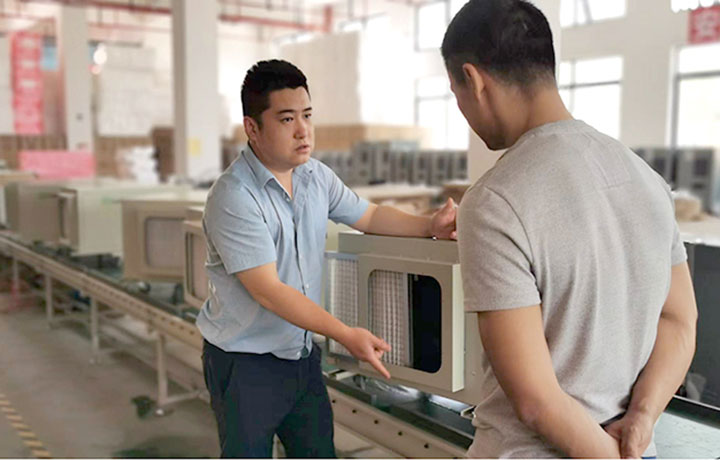
Hybrid units are assembled and tested as complete two-stage systems before dispatch.
When the extra capital pays back
The trade-off is real: a hybrid costs 15–25% more than a single-stage unit and needs a condensate drain plus refrigerant service. On dry inlet air or small airflows, the coil has nothing useful to do and that extra capital never returns. Size the coil for the summer design day and the regeneration heater for the winter case — the split between the two stages moves with the weather.
Measured Data: RH vs Achievable Dew Point
The table below converts common target conditions into dew points and shows what each one demands from a coil. It is the fastest way to see whether your specification has already — knowingly or not — chosen a technology.
| Target condition | Dew point | What the coil must do | Practical technology |
|---|---|---|---|
| 24 °C / 60% RH | ≈ 16 °C | Easy condensation | Refrigerant |
| 20 °C / 55% RH | ≈ 11 °C | Comfortable range | Refrigerant |
| 18 °C / 50% RH | ≈ 7 °C | Colder coil, reduced capacity | Refrigerant (low-temp rated) |
| 15 °C / 40% RH | ≈ 2 °C | Coil at the frost line, frequent defrost | Marginal — verify or switch |
| 12 °C / 35% RH | ≈ −3 °C | Coil below freezing | Desiccant |
| 10 °C / 30% RH | ≈ −7 °C | Coil well below freezing | Desiccant |
Dew points are calculated at sea-level pressure and rounded to the nearest degree. A specification that names 35% RH — or any dew-point requirement below freezing — has already specified a desiccant machine, whether the writer realised it or not.
Cost of Getting Below 30% RH
The economics flip at the frost line. In warm humid air, condensing plant is the cheapest way to remove water, running at a COP of roughly 2.8–3.5 (about 1.5–2.5 kg of water per kWh). Below 40% RH the only options are desiccant or hybrid, and both carry a higher energy bill per kilogram.
| Metric | Condensing | Desiccant rotor | Hybrid (2-stage) |
|---|---|---|---|
| Works below 40% RH | No | Yes | Yes |
| Practical RH floor | ≈ 35–45% | 1–10% | 1% and below |
| Lowest useful dew point | ≈ +5 °C | −40 to −70 °C | −40 °C at lower energy |
| Energy per kg removed | 0.5–1.5 kWh | 1.0–3.0 kWh | 20–30% less than rotor-only |
| Initial cost | Lowest | Higher | 15–25% above rotor |
| Exhaust / services | Drain only | Insulated regeneration duct | Drain + regeneration duct |
Where the regeneration energy can be recovered
Regeneration typically accounts for 30–40% of a rotor's total power draw — but it does not have to come from electricity. If the site has waste heat or steam, the regeneration heater can run on energy the plant was already throwing away, which can push running cost close to (or below) a condensing unit on the same duty. Before you reject a rotor on energy grounds, check what heat is available on site.
Choosing the Right Unit for Low RH
Boil the whole decision down to three questions: what is your target RH, what is the lowest ambient temperature, and what is your dew-point specification — if any.
- Above 50% RH and warmer than 15 °C → condensing plant; the cheapest and simplest answer.
- 40–50% RH → a condensing unit with a verified low-temperature rating may hold, but confirm the dew point and how long it spends in defrost before you commit.
- Below 40% RH, below 5 °C, or any dew-point spec → a desiccant rotor is the only reliable route.
- Warm humid inlet + low dew-point target → a hybrid two-stage unit to cut regeneration energy.
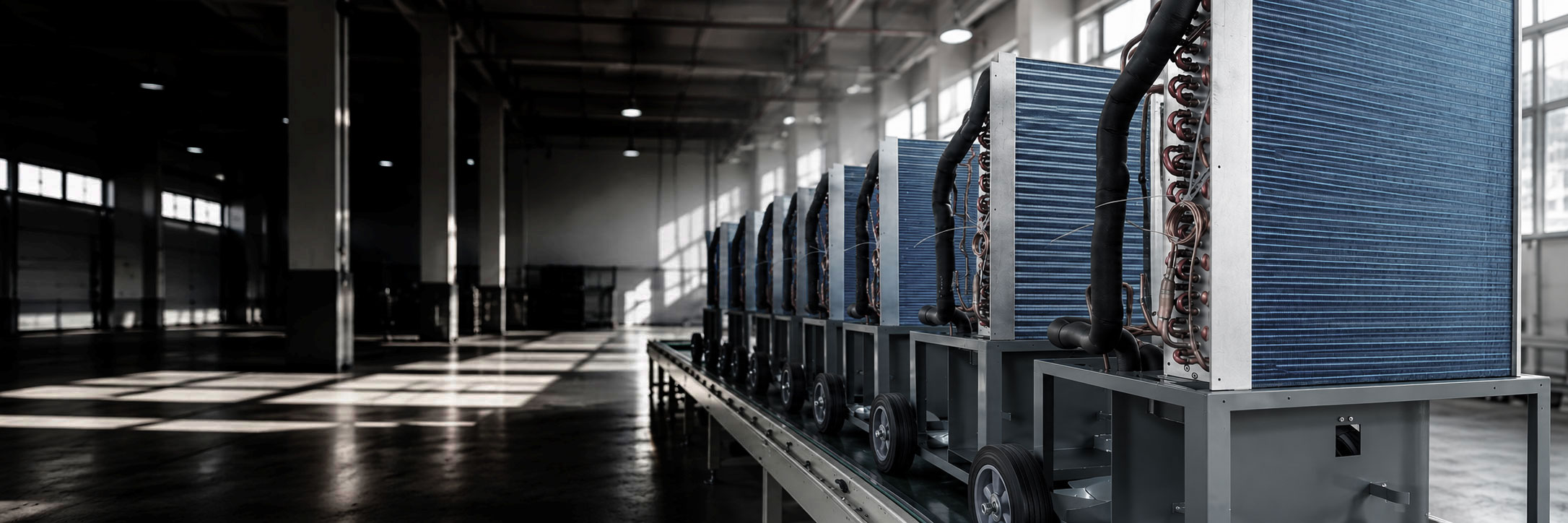
East Dehumidifier runs both condensing and desiccant plant, so the specification follows the duty point.
One caution applies to every low-RH project regardless of equipment: seal the space first. Low-humidity rooms fail more often from infiltration — doors, dampers, cable penetrations — than from an under-specified machine. Fix the leakage, then size the dehumidifier for the real remaining load.
If your target sits below the condensing floor and you want a unit sized to your exact duty point rather than a catalogue pick, our technical team can run the psychrometric numbers for you — send an inquiry with your target RH, room temperature and dimensions and we will reply with a specification.